
Introduction
The history of the European Union is a story of countries with different agendas, interests, political, and economic backgrounds that chose to cooperate closely in order to become stronger altogether. After World War II, Winston Churchill famously advocated for the creation of a “United States of Europe,” inspired by the strength and unity demonstrated by the United States of America. History, as it often does, repeats itself. To predict what might happen in the future, we must study the past. So, where should we look for paradigms? As always, let’s turn to ancient Greece.
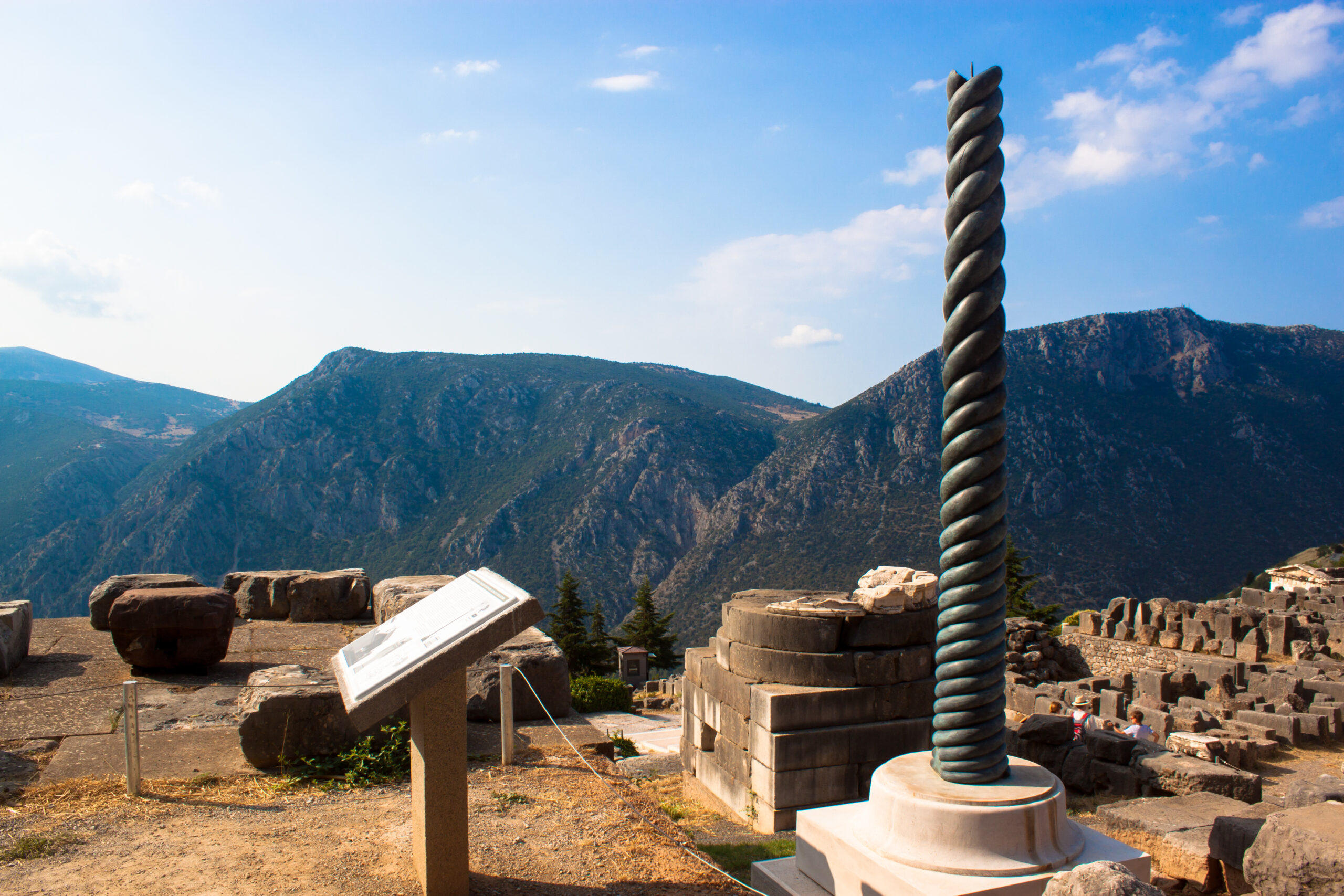
If you are ever fortunate enough to visit Delphi, you will encounter the remarkable Serpent Column, also known as the Plataean Tripod. This monument consists of a bronze column made up of three intertwined serpents, supporting a golden tripod. Standing about 8 meters (26 feet) high, the column is intricately designed with the serpents’ bodies spiraling upwards. The base of the column bears an inscription listing the names of the 31 Greek city-states that participated in the battle and contributed to the victory. This inscription honors the collective effort and cooperation of the Greek allies. The Serpent Column was not only a religious offering but also a political statement. It emphasized the shared Hellenic identity and the triumph of the Greek city-states over the Persian Empire. The dedication at Delphi, a major pan-Hellenic sanctuary, further reinforced the unity and cultural pride of the Greeks.
At this unique place, the presents come from each state separately. But this amazing statue is a collective gift from all the cities. The statue is so distinctive that Emperor Constantine the Great took it to Constantinople. In Delphi, there is now a replica. But what exactly happened then, and what is the relationship between those events and the formation of the European Union?
The Battle of Plataea: A Decisive Moment in Greek History
Background of the Greco-Persian Wars
The Battle of Plataea, fought in 479 BCE, was the final major land battle during the second Persian invasion of Greece. This period of conflict, known as the Greco-Persian Wars, began with the Ionian Revolt (499-493 BCE) and included famous battles such as Marathon (490 BCE), Thermopylae (480 BCE), and Salamis (480 BCE).
The Persian Empire, under King Xerxes I, sought to subjugate the Greek city-states, which were known for their fierce independence and frequent internal conflicts. Despite their differences, the Greeks managed to form alliances to defend their homeland against the vast Persian army.
Formation of the Hellenic League
In response to the Persian threat, several Greek city-states formed the Hellenic League in 481 BCE. The league was a coalition of city-states, including Athens, Sparta, Corinth, and others, who agreed to put aside their rivalries and unite against the common enemy. This alliance was formalized during the Congress at Corinth, where the delegates agreed on a strategy and assigned leadership roles. Sparta was given command of the land forces, while Athens led the naval forces.
The Persian Invasion
The Persian invasion of 480 BCE saw initial successes, including the infamous Battle of Thermopylae, where King Leonidas of Sparta and his 300 Spartans made a legendary last stand. Despite their bravery, the Persians advanced, capturing and burning Athens. However, the Greek naval victory at Salamis dealt a significant blow to the Persian fleet and shifted the momentum.
Prelude to Plataea
By 479 BCE, the Persian forces, now under the command of General Mardonius, had retreated to central Greece. The Greek allies, buoyed by their naval success at Salamis, gathered a large army to confront the Persians. The Greeks assembled their forces near the city of Plataea in Boeotia.
The Battle
The Battle of Plataea was marked by strategic maneuvers and intense fighting. The Greek forces, numbering around 38,000 hoplites (heavily armed infantry) and a larger contingent of light troops, faced a Persian army estimated at 120,000.
For several days, both armies engaged in skirmishes without committing to a full-scale battle. The Greeks, positioned on higher ground, managed to frustrate Persian attempts to draw them into open combat. The turning point came when the Greek forces, appearing to retreat to a more secure water supply, lured the Persians into a premature attack.
The Greeks, led by the Spartans and Athenians, swiftly regrouped and launched a counter-attack. Spartan hoplites played a crucial role, breaking through the Persian lines and killing Mardonius. The Persian army, demoralized by the loss of their commander, fled the battlefield. The Greeks pursued the fleeing Persians, inflicting heavy casualties and securing a decisive victory.
Thebes: A Story of Betrayal and Consequence
Amidst the Greek city-states that rallied against the Persian threat, Thebes stands out for its controversial decision. Unlike the other Greek states, Thebes chose to support the Persian invaders. This decision was driven by a combination of political calculations, internal dynamics, and perhaps a strategic gamble that Persia would emerge victorious and dominant in the region.
The Choice to Medize
Thebes’ decision to medize, or ally with the Persians, was seen as a significant betrayal by the other Greek city-states. The Thebans provided troops and support to the Persian forces, believing that their alliance with the powerful empire would secure their own interests and position in Greece. This choice, however, isolated Thebes from the Greek coalition and marked them as traitors in the eyes of their fellow Greeks.
Aftermath of the Battle
Following the Greek victory at Plataea, the Thebans faced severe consequences for their alignment with the Persians. The Greek coalition, viewing Thebes’ actions as the greatest betrayal, decided to punish the city harshly. Thebes was besieged, and the Greek allies demanded the surrender of the leaders who had supported the Persian cause. Several Theban leaders were executed, and the city was significantly weakened.
The punishment meted out to Thebes served as a stark warning to other city-states about the cost of treachery and the importance of solidarity in the face of external threats. Thebes, once a major power in Greece, never fully recovered from this blow to its political and military strength. The city’s betrayal and subsequent downfall underscore the high stakes of choosing sides in such pivotal conflicts.
Aftermath and Significance
The Battle of Plataea effectively ended the Persian invasion. It was a landmark victory for the Greek city-states, ensuring their independence and preserving their culture. The success at Plataea demonstrated the power of unity and cooperation among the Greek city-states, who had set aside their differences to face a common threat.
Parallels with the European Union
The Birth of the European Union
The European Union (EU) was established in the aftermath of World War II, a time when Europe was devastated by conflict and in desperate need of rebuilding. The idea of a united Europe was driven by the desire to prevent future wars and foster economic cooperation. Winston Churchill’s call for a “United States of Europe” highlighted the need for a new political and economic framework to ensure peace and prosperity.
Founding Principles
The EU was founded on principles similar to those that guided the Greek city-states during the Greco-Persian Wars. These principles include:
- Unity and Cooperation: Just as the Greek city-states set aside their differences to face the Persian threat, European countries chose to cooperate closely to rebuild their economies and ensure lasting peace.
- Shared Identity: The Greeks emphasized their shared Hellenic identity in their fight against Persia. Similarly, the EU promotes a sense of European identity, fostering unity among diverse cultures and nations.
- Collective Strength: The Greek victory at Plataea demonstrated the power of collective strength. The EU, through economic and political integration, aims to leverage the collective strength of its member states to address common challenges.
Key Events
Marshall Plan and Economic Cooperation
In the early years, the Marshall Plan provided critical economic aid to European countries, helping them recover from the devastation of World War II. This aid was contingent on cooperation, encouraging countries to work together for mutual benefit.
Formation of the European Coal and Steel Community
The European Coal and Steel Community (ECSC), established in 1951, was a significant step towards European integration. It aimed to create a common market for coal and steel, industries vital to military power. By integrating these industries, the ECSC made war between member states not only unthinkable but materially impossible.
Treaty of Rome and the European Economic Community
The Treaty of Rome, signed in 1957, established the European Economic Community (EEC), further promoting economic integration. The EEC aimed to create a common market and a customs union, fostering economic interdependence among member states.
Modern European Union
Expansion and Deepening Integration
The EU has grown from its original six members to 27, expanding its influence and promoting deeper integration. The Single European Act (1986) and the Maastricht Treaty (1992) were pivotal in this process, leading to the creation of the single market and the introduction of the euro.
Common Policies and Institutions
The EU has developed common policies in areas such as agriculture, fisheries, and regional development. It has also established institutions, including the European Parliament, the European Commission, and the European Court of Justice, to oversee and implement its policies.
Challenges and Resilience
The EU has faced numerous challenges, including economic crises, political divisions, and the recent Brexit referendum. Despite these challenges, the EU has demonstrated resilience, adapting and evolving to address new issues while maintaining its core principles of unity and cooperation.
Lessons from Plataea for the European Union
The Importance of Unity
The Battle of Plataea underscores the importance of unity in the face of external threats. Just as the Greek city-states united to repel the Persian invasion, European countries must continue to cooperate to address common challenges, such as economic instability, climate change, and security threats.
Strength in Diversity
The diverse backgrounds and interests of the Greek city-states did not prevent them from forming a successful alliance. Similarly, the EU’s strength lies in its diversity. Each member state brings unique perspectives and strengths, contributing to the overall resilience and capability of the Union.
Collective Decision-Making
The Greek coalition’s ability to make collective decisions, despite their differences, was crucial to their success. The EU’s decision-making processes, which involve negotiation and consensus among member states, reflect a similar approach. This collective decision-making ensures that policies and actions are balanced and consider the interests of all members.
Facing Betrayal and Internal Conflict
The story of Thebes serves as a cautionary tale about the consequences of betrayal and internal conflict. Thebes’ decision to side with the Persians led to its downfall and punishment by the other Greek city-states. In the context of the EU, maintaining unity and addressing internal conflicts constructively is essential to prevent division and ensure the stability and success of the Union.
Conclusion
The Battle of Plataea and the formation of the European Union share remarkable similarities in their stories of unity, cooperation, and collective strength. Both historical events highlight the importance of setting aside differences to face common challenges and the power of working together for mutual benefit.
The Serpent Column at Delphi stands as a lasting symbol of the Greek victory and the unity that made it possible. Similarly, the European Union represents the triumph of cooperation and shared identity over division and conflict. By studying these historical paradigms, we can gain valuable insights into the principles that underpin successful alliances and the importance of unity in achieving common goals.
As the EU continues to evolve and address new challenges, the lessons from ancient Greece remind us that unity and cooperation are the keys to enduring strength and prosperity. Just as the Greek city-states came together to defeat a formidable enemy, the nations of Europe can continue to build a strong and united future by working together, embracing their diversity, and upholding the principles of collective strength and shared identity.